
Swing gates, sliding gates, operators, arms, hinges and access controls, from the crew that does your garage door.
Tell us what the door is doing. The estimate is free and you can say no.
If your gate has stopped, slowed, sagged or started making a noise, this is the page. We repair swing gates and sliding gates around Pittsburgh, the operators and arms that move them, the hinges and posts that hold them up, and the keypads, remotes and sensors that tell them what to do.
Most of the gates we see are not exotic. A pair of iron leaves on a linear arm, an aluminum slider on a chain drive, a steel gate on a rack and pinion. What they share is that they live outdoors, carry real weight, and get ignored until the morning they will not open.
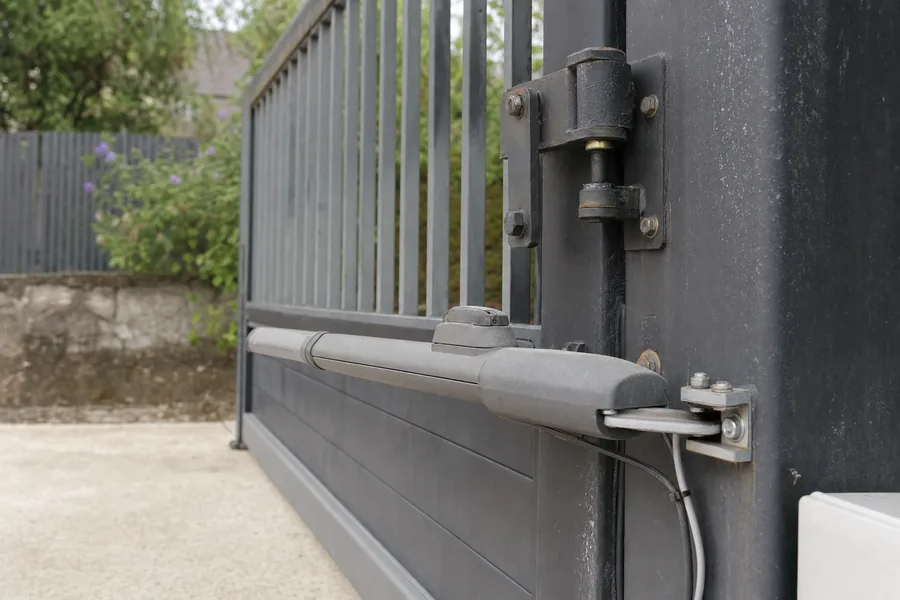
Nearly every gate call comes down to one of the parts below. We check them in this order because that is the order they fail in, and it keeps a stuck gate from turning into a guessing game.
A steel double gate can weigh four hundred pounds a leaf. The hinges carry that all day, the post carries the hinges, and the ground carries the post. When any one of those shifts, the leaf drops at the latch side and the operator starts lifting as well as swinging. Nothing in a linear arm is built for lifting.
We see the same thing on sliders. A ground track that has heaved, a roller bearing that has seized, and the chain drive takes the strain until the gear strips. The repair is at the track, and the operator usually survives once the gate runs free again.
Most gate repairs are done in the same visit because the parts that fail are the parts we carry.
Two things drive the timing here: freeze-thaw winters, and the ground the posts are set in. When repeated freeze-thaw cycles crack panels and seize rollers, the gate hardware suffers first because it has no garage around it. We can nearly predict the week the calls start.
Posts move, tracks fill, batteries fade, and safety devices get knocked out of line by a mower or a delivery truck. None of it is dramatic. It builds until the morning the gate stalls and the car is on the wrong side of it.
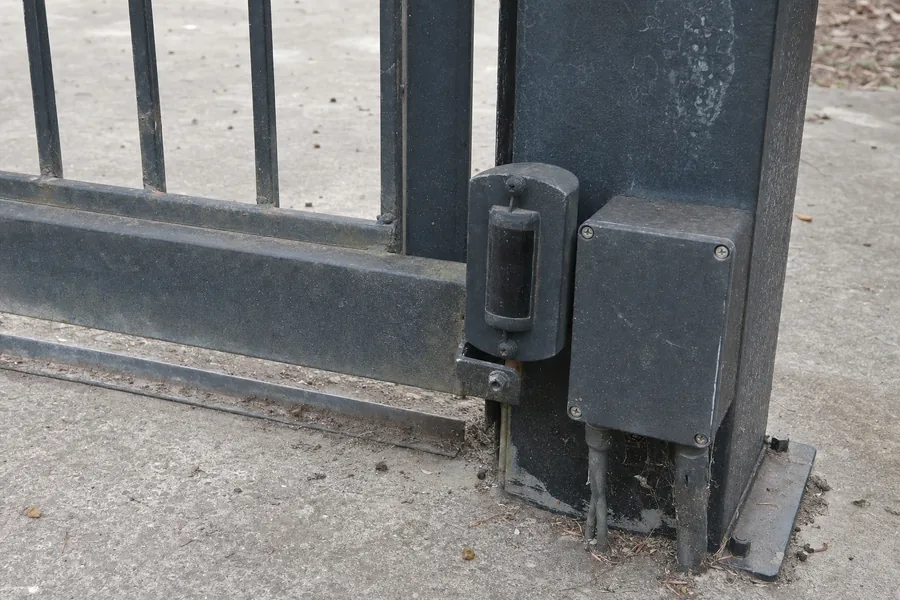
If it runs, has a board that can still be had, and is rated for the gate, it stays. We change the part that failed and leave the rest alone. If the motor has cooked, the brand has gone, or the machine has been fighting a gate twice its rating, we say so and show you why.
New installs are sized to the leaf, not the brochure. Where there is no mains power at the gate, a solar operator with a proper battery is a real option and not a compromise, provided the panel has sun.
A gate that ignores the remote but answers the keypad has a receiver problem, not a gate problem. A gate that will not open for a car leaving has a loop problem. A gate that will not close has a photo eye problem. These are quick to prove and quick to put right, and they are where we look before anyone talks about a new operator.
We handle the whole control side: programming, receivers, keypads, intercoms and phone entry, exit and safety loops, and the sensors and edges that stop the gate hurting anyone.
Look at the operator. Is there a light on it? Is the plug in, is the breaker up, has the solar panel been buried in leaves? Try the keypad if the remote failed, and the remote if the keypad failed. Look for anything across the beam of the photo eyes. Then call, and tell us what you found.
Do not push a gate that is still connected to its arm. Use the release. A bent arm is the most common thing we replace that did not need replacing.
Most residential gates here run on LiftMaster, Mighty Mule, Nice or Apollo, Viking, DoorKing, Linear, Elite, FAAC, GTO or Ghost Controls. We service all of them and replace the ones that cannot be saved. The parts that fail most, boards, batteries and arms, travel with us for the brands we see most in Pittsburgh.
Nine times out of ten a photo eye or safety edge. Something is in the beam, the eye has been knocked out of line, or it has failed. It is a safety device doing its job, and it is a quick fix.
Most of the time, yes. The parts that fail most often are on board for the brands we see most. Where something has to be ordered you hear it from the technician on the spot.
We treat it as one. A property open to the street gets the same priority as a garage door that will not close, and if the gate cannot be fixed that visit it is secured shut until it can.
Most of the time. Operators fail in parts, and parts get replaced. The exceptions are a cooked motor, a discontinued brand, and an operator that was undersized for the gate to begin with.
Yes, if the gate swings or slides freely by hand and the posts are sound. We check both first, because an operator on a gate that binds does not last.
Yes, and receivers, intercoms, phone entry and loop detectors as well. Control faults are a large share of gate calls and rarely need a new operator.
More, if anything, because they live outdoors. Once a year: hinges and rollers lubricated, track cleared, battery tested, photo eyes and reversal checked, force settings confirmed.
Around Pittsburgh, one call gets you a two-hour slot and a heads-up call before the technician sets off. We don't buy leads and nobody on a phone judges a door they can't see.
Free estimate across Pittsburgh, PA and the towns around it.
Tell us what the gate is doing and you'll get a real arrival window. The visit and the estimate is free, anywhere in Allegheny County.
Prefer to talk it through? Call (412) 226-4206.
Tell us what the door is doing. The estimate is free and you can say no.