Pittsburgh, PA
Garage Door Cable and Roller Repair in Pittsburgh
Frayed strands near the bottom bracket are the warning. Snapped is the emergency, and it usually takes the door off its track with it.
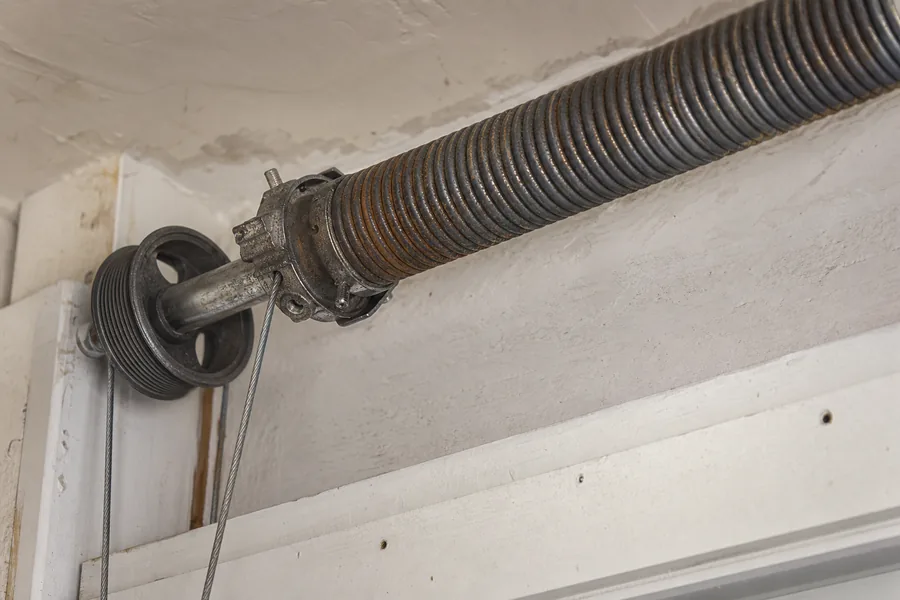
Frayed strands near the bottom bracket are the warning. Snapped is the emergency, and it usually takes the door off its track with it.
A snapped cable or seized roller is the fault we are called out for most often in Pittsburgh, and it is the one homeowners least expect. Nothing wears visibly, nothing sounds wrong, and then one morning the door will not lift and the car is shut in. Around Squirrel Hill and Shadyside we see it concentrated in steep-driveway rowhouses and hillside garages built into the slope, where repeated freeze-thaw cycles crack panels and seize rollers.
The spring cancels the weight, but it is the two cables that actually carry it. Each runs from a bracket at the bottom corner of the door, up the side, and winds onto a grooved drum at the end of the torsion shaft. Lose one and that corner of the door falls, jams in its track, and takes the door off the rails - which is why a snapped cable and a derailed door are so often the same phone call.
We cover Pittsburgh and the towns around it - Mount Lebanon, Bethel Park, Monroeville, Robinson - and the price goes in writing before any work starts. There is no charge for coming out to look, and no charge if you decide against the quote.
A cable about to fail tells you first. Look along its length for broken strands standing out from the lay of the wire, and check whether one side has gone slack while the other is taut. If the door has begun to sit crooked, the cable has already slipped a drum.
If any of that matches, a technician can diagnose it on site in about ten minutes. We do not guess at it down the phone, and we do not charge to look.
It can, but what it breaks is not just the cable. The door drops on that side, jams in the track and usually comes off the rails, so a cheap cable job becomes a track and hinge job. Frayed strands are the warning, and they are worth acting on.
Cables are replaced in pairs. They have carried the same load for the same years, and the drums have to be set equally or the door will never sit level in the opening.
Builder-grade plastic rollers have no bearings and are finished in five to seven years. Nylon rollers on sealed ball bearings run quieter, drag far less on the track and last several times longer for a small difference in parts cost.
None of that is unique to Pittsburgh. It is simply what happens when a door is quoted over the phone by somebody who has not seen it, and it is the reason we do not give prices before a technician has stood in front of the door.
None of this involves touching anything under tension, and all of it makes the phone call shorter and the estimate more accurate. Two minutes in the garage with the door down is enough.
Whatever you find, do not try to correct it. The value is in the description you give us, not in the repair - a technician arriving in Pittsburgh who already knows what failed arrives with the right part on the van.
A quote is only comparable if you know what is in it. This is what a garage door cable and roller repair in Pittsburgh covers, every time, whether the invoice is large or small.
None of that is optional or extra. It is what the job is, and it is why we would rather quote in writing on site than call out a number over the phone.
A quote well below everybody else is almost always one of three things, and it is worth knowing which before you take it.
It is a builder-grade part where a better one costs a little more - the classic being a 10,000-cycle spring on a door that is opened six times a day, which puts you back where you started in about four years.
It is one side of a two-side job, leaving the second spring or the second cable to fail a few weeks later and the labor to be paid twice.
Or it is a phone number rather than a price, with the real figure arriving once the technician is in your garage and your car is behind a door that will not move.
None of that means the lowest quote is wrong. It means the three questions worth asking are: what is the part, is it both sides, and is this price fixed.
The honest answer changes with the door, so this is the test we actually apply in Pittsburgh rather than a rule of thumb.
| Situation | What we recommend |
|---|---|
| Opener over fifteen years old, board failed | Replace the opener only. A modern head is quieter and carries its own warranty. |
| Wooden door that has begun to swell and bind | Depends entirely on the frame. Worth a look before you commit to either. |
| Spring, cable or roller failure on sound panels | Repair. These are consumable parts on a door with decades of life left in it. |
| Damage or rot across two or more panels | Replace. Section-by-section repairs stop making financial sense at that point. |
| Door is off its track after an impact | Repair first. Realign, find the cause, and only then judge whether panels are sound. |
| Door works but is deafening | Repair. Nylon rollers, new hinges and a proper service usually solve it. |
We will say when a repair is the better money even though the replacement is the bigger invoice. A door fixed properly that lasts another decade is worth more than one sale, because Pittsburgh is not a big enough place to work any other way.
A galvanized cable lasts as long as its coating does. The end that sits at the bottom bracket lives closest to a floor that gets wet, so that is where the zinc goes first, and that is where the strands start to part. Rollers are a shorter story: the unsealed plastic ones builders fit have no bearings worth the name and are finished inside seven years.
Cables are replaced in pairs, because they have worn the same amount and the drums have to be set equally or the door will never sit level. Nylon rollers with sealed ball bearings are the upgrade worth having - quieter, and they outlast the plastic ones several times over.
A roller that has stopped turning does not stay a roller problem. It drags, and what it drags is the track, so a cheap part left too long becomes a track section and a realignment. If the van is already there for a cable, the rollers cost parts and almost no extra labor.
These are the variables. They are the reason a number given down the phone by somebody who has not seen your door is a guess, and the reason the visit is free.
| Factor | Why it matters |
|---|---|
| Pairs, not singles | Cables are replaced two at a time. It is not an upsell, it is the only way the door sits level afterwards. |
| Bottom bracket condition | Corroded bottom brackets get replaced. They are under full spring load and they are not a part to leave. |
| Roller grade | Unsealed plastic, sealed nylon or steel ball-bearing rollers are three prices and three service lives. Nylon is the sensible middle. |
| Shaft play | A shaft with movement in the center bearing eats cables. Worth checking while everything is apart. |
| Drum wear | Grooves worn into a drum will chew a new cable. Worth checking while it is apart, and cheap to do then. |
That is the whole list. There is no separate call-out, no diagnostic charge and no paperwork fee waiting at the end of it.
Almost every early failure we see in Pittsburgh traces to one of four things, and all four are within a homeowner's control.
An unbalanced door. If the spring is not carrying the weight, the opener is, and the nylon gear inside it is the least costly part in the assembly. An opener that strains is an opener with months left.
Dry hardware. Hinges and rollers that have never been lubricated add drag to every cycle, and drag is spent cycle life. It is the difference between a spring reaching its rating and falling well short of it.
Ignored warnings. A frayed cable, a seized roller or a door that has started to sit crooked is a cheap repair for a few weeks and an expensive one afterwards.
And forcing it. Every attempt to run a door that has already failed moves load onto parts that were not designed to carry it.
Almost every residential door in Pittsburgh is standard torsion hardware, and standard hardware is what the van carries. Two exceptions come up often enough to be worth naming: Wayne Dalton's TorqueMaster, where the spring lives inside the tube, and the direct-drive European heads.
| Brand | Notes |
|---|---|
| Amarr | Sections and hardware are widely available and the tracking is standard, which keeps repair costs sensible. |
| LiftMaster / Chamberlain | The same units under two names. Gear kits, logic boards and Security+ 2.0 remotes are stocked, and the older 315MHz heads can still be paired. |
| Chamberlain myQ | Wi-Fi hubs and the app side fail more often than the mechanics do. Usually a re-pair rather than a replacement. |
| Craftsman | Built on Chamberlain internals for most of their production run, so the gear kits and boards are shared and readily available. |
| Overhead Door / Raynor | Standard torsion hardware on the residential lines - nothing unusual to source. |
| Wayne Dalton | The TorqueMaster counterbalance is a spring inside the tube rather than on it, and it needs its own tools and its own parts. We carry them. |
Not listed is not a problem. Residential doors are overwhelmingly standard hardware, and the handful that are not are identified from the model number in about ten seconds on the phone.
Pittsburgh is the base and the surrounding towns are within the normal working radius. These are the areas the van is in most days:
Emergency and after-hours calls run to the same map. A door standing open overnight anywhere on that list gets somebody out.
Yes - Mount Lebanon, Bethel Park, Monroeville, Robinson and the wider Allegheny County area are all inside our normal service radius.
If a spring or cable has failed, no. Leave it down and do not force it. The counterbalance holds a great deal of stored energy and it can let go without warning.
No. The visit and the written estimate are free anywhere in Allegheny County. You pay only if you agree the price and we do the work.
A roller that has seized takes the track with it, so a roller replacement that is left too long turns into a track repair. If we are already there for a cable, changing the rollers at the same time costs the parts and almost no extra labor.
Yes - LiftMaster, Chamberlain, Genie, Craftsman, Clopay, Amarr, Wayne Dalton and the rest. The mechanisms are common across brands and we carry parts for all of them.
Most garage door cable and roller repair jobs are finished within the same visit, typically under two hours.
Tell us what the door is doing, what it sounds like and roughly how old it is. That is normally enough to know what has failed and what the van needs to bring.
The visit is free, the written estimate is free, and there is nothing to pay if you decide against it. Pittsburgh, Mount Lebanon, Bethel Park, Monroeville, Robinson and the rest of Allegheny County.
A two-hour window rather than a day, and a call before the technician sets off. Free throughout Allegheny County, with nothing to pay if you decide against the quote.
Prefer to talk it through? Call (412) 226-4206.
The most common call we take, and the one job on a door that genuinely hurts people. Measured and matched to your door rather than fitted from whatever is on the van.
What this costs and how fast →Before you buy a new one: an opener that strains is usually reporting a spring problem, not an opener problem. Replacing the head will not fix that.
What this costs and how fast →Rollers reseated, hinges checked for the damage a derailment hides, and the track trued against a level. Then we find what put it there.
What this costs and how fast →The fault is ordinary - a spring, a cable, a derailed door. What makes it urgent is what it has trapped. Secured first, repaired second.
What this costs and how fast →When the panels are past saving. Measured for headroom, track set plumb, counterbalance sized to the finished door - not to the invoice.
What this costs and how fast →