Pittsburgh, PA
Broken Garage Door Spring Repair in Pittsburgh
Rated in cycles, not years, and it uses them faster than anyone expects. When it breaks the full weight of the door lands on a motor built to position it, not lift it.
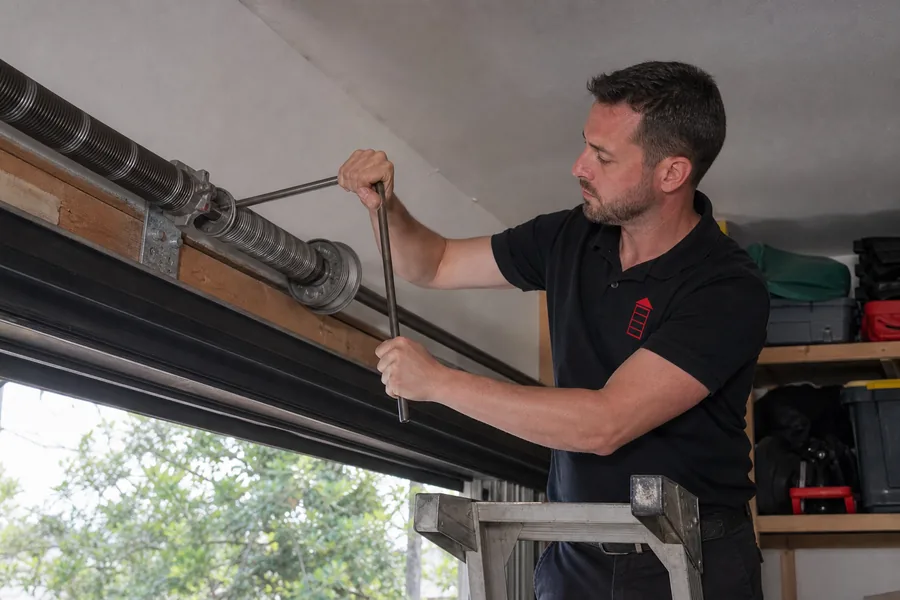
Rated in cycles, not years, and it uses them faster than anyone expects. When it breaks the full weight of the door lands on a motor built to position it, not lift it.
When a broken torsion spring happens in Pittsburgh it happens without warning. The parts that fail are the ones under constant load, and they give out on an ordinary morning rather than during a storm. Across Allegheny County the pattern is consistent: repeated freeze-thaw cycles crack panels and seize rollers, and steep-driveway rowhouses and hillside garages built into the slope take the worst of it.
Lift a garage door with the spring disconnected and you understand the whole system in about two seconds. It is 130 to 190 pounds of steel on a double, and considerably more insulated. The torsion spring above the opening is wound to store almost exactly that much energy, so the two cancel and the door floats. The half-horsepower motor on the ceiling is a positioning device for a weightless object. Take the spring out of that equation and the motor is asked to deadlift something it was never rated for.
Anywhere in Pittsburgh or Mount Lebanon, Bethel Park, Monroeville, Robinson, there is no trip fee and no diagnostic fee. If you decide not to go ahead after seeing the estimate, you owe nothing.
Neighbors describe it as a gunshot or a car door slammed far too hard. It usually happens with nobody in the garage, and often at three in the morning, because steel contracts as the space cools and a spring at the end of its life will choose the coldest hour to let go. The next person to press the button finds a motor that strains, lifts the door two inches, and stops.
If any of that matches, a technician can diagnose it on site in about ten minutes. We do not guess at it down the phone, and we do not charge to look.
A spring that is too strong is as wrong as one that is too weak - the door creeps open on its own, the opener fights it on the way down, and the safety reversal stops working correctly. The spring is matched to the door's actual weight, not upgraded past it.
You can, and we will if that is what you want. But both springs were wound the same number of cycles on the same day, so the second one is not far behind, and you pay the call-out and the labor twice. We quote both and let you choose with the numbers visible.
It almost never does. The spring is a consumable part on a door that lasts twenty to thirty years, and replacing it is a parts-and-labor job on a door that is otherwise sound. Anyone who leads with a replacement quote before looking at the panels is selling, not diagnosing.
None of that is unique to Pittsburgh. It is simply what happens when a door is quoted over the phone by somebody who has not seen it, and it is the reason we do not give prices before a technician has stood in front of the door.
None of this involves touching anything under tension, and all of it makes the phone call shorter and the estimate more accurate. Two minutes in the garage with the door down is enough.
Whatever you find, do not try to correct it. The value is in the description you give us, not in the repair - a technician arriving in Pittsburgh who already knows what failed arrives with the right part on the van.
Below is the actual scope of a broken garage door spring repair, so you can hold any estimate - ours included - against it.
None of that is optional or extra. It is what the job is, and it is why we would rather quote in writing on site than call out a number over the phone.
It is worth knowing how the other model works, because it explains most bad experiences with garage door repair.
A national number takes your details and sells them, sometimes to several contractors at once. Whoever calls you first has paid for the privilege, and that cost is in your invoice before anybody has looked at the door. It is also why the price on the phone and the price on the driveway are often different numbers.
We are the people who turn up. The number on this page reaches somebody who can book the van, and the technician who arrives is the one who quoted it.
The practical difference in Pittsburgh: an arrival window you can plan around, a written estimate that costs nothing, and a fixed price agreed before any tool comes out.
A range is a way of not committing. It protects the contractor and tells you almost nothing, and it is why so many garage door jobs end up costing more than the homeowner expected.
We do it the other way round. The visit costs nothing, the technician sees the actual door, and you get one number in writing for the work described. If you want to think about it, or get another quote, that is normal and there is no charge for having wasted anybody's time - you did not.
The number depends on real things: door weight, spring specification, what else broke when the first thing broke, and whether the job is one side or two. Nothing in that list can be known down a phone line, which is the whole reason the visit is free.
That applies across Allegheny County and the towns around it, at any hour.
A residential torsion spring is rated in cycles, not years. The standard spring supplied with most doors is a 10,000-cycle spring, and one cycle is one trip up and one trip down. A household that opens the door four times a day uses about 1,460 cycles a year, so the arithmetic gives seven years. A household with two working adults and a teenager can double that rate and see the spring go in three.
Three numbers define a spring: wire gauge, inside diameter, and length. All three have to suit the weight of your door, which is why the technician measures the old spring and, where there is any doubt, weighs the door. A near-enough spring will lift it. It will also cycle out early, and you will pay the labor a second time.
Springs on a two-spring door are wound the same number of cycles and age together. If one has gone, the other is at the same point in its life and is usually weeks behind. Replacing one and leaving the other means paying the labor twice, which is why we quote both and let you decide with the numbers in front of you.
Nothing here is an upsell. Each one genuinely changes what the work involves, and each one has to be looked at rather than assumed.
| Factor | Why it matters |
|---|---|
| Cycle rating | A 10,000-cycle spring and a 25,000-cycle spring are different parts at different prices. On a door opened six times a day the second one is the cheaper choice over its life. |
| Bearing and shaft condition | A worn center bearing puts the next spring out of true. Cheap to deal with while the shaft is exposed and expensive afterwards. |
| Collateral damage | A spring that let go can take a cable, a drum or a bearing plate with it. That is found on the visit and quoted before it is done. |
| Door age | On a door old enough that panel sections are no longer made, we will say so before you spend on a spring. |
| One side or two | Two-spring doors age together. Doing one now and one in a month means paying the labor twice. |
That is the whole list. There is no separate call-out, no diagnostic charge and no paperwork fee waiting at the end of it.
The honest answer changes with the door, so this is the test we actually apply in Pittsburgh rather than a rule of thumb.
| Situation | What we recommend |
|---|---|
| Repairs arriving more than once a year | Replace. You are paying for a new door in installments and not getting one. |
| Door works but is deafening | Repair. Nylon rollers, new hinges and a proper service usually solve it. |
| Spring, cable or roller failure on sound panels | Repair. These are consumable parts on a door with decades of life left in it. |
| Damage or rot across two or more panels | Replace. Section-by-section repairs stop making financial sense at that point. |
| Opener over fifteen years old, board failed | Replace the opener only. A modern head is quieter and carries its own warranty. |
| Door is off its track after an impact | Repair first. Realign, find the cause, and only then judge whether panels are sound. |
We will say when a repair is the better money even though the replacement is the bigger invoice. A door fixed properly that lasts another decade is worth more than one sale, because Pittsburgh is not a big enough place to work any other way.
You do not need tools and you do not need to touch anything under tension. Stand in the garage with the door shut and look at four things.
The springs above the door: any orange-brown bloom on the coils is surface rust, and surface rust is where the spring will eventually break. The gap in a broken spring is obvious once you know to look for it.
The cables running down each side: follow them to the bottom brackets and look for strands standing proud of the lay of the wire. Frayed is the warning; snapped is the emergency.
The rollers: spin one with a finger. It should turn freely. A roller that will not turn is dragging in the track and taking the track with it.
And the balance: release the opener with the door down, lift by hand to waist height, and let go. It should stay. Anything else means the counterbalance needs setting.
Garage door mechanisms are far more alike than the badges suggest, and the parts that fail are common across brands. These are the ones we see most in Pittsburgh.
| Brand | Notes |
|---|---|
| Wayne Dalton | The TorqueMaster counterbalance is a spring inside the tube rather than on it, and it needs its own tools and its own parts. We carry them. |
| Clopay | The most common door brand we work on. Panels, hinges and struts are orderable individually, so one damaged section does not mean a whole door. |
| Genie | Screw-drive and belt-drive heads. Intellicode remotes and carriage assemblies are the usual failure points, and both are parts rather than a reason to change the opener. |
| Overhead Door / Raynor | Standard torsion hardware on the residential lines - nothing unusual to source. |
| Sommer / Marantec | Less common here, direct-drive heads, and the parts have to be ordered - so we confirm the model before the van is loaded. |
| Craftsman | Built on Chamberlain internals for most of their production run, so the gear kits and boards are shared and readily available. |
If yours is not there, it is almost certainly still standard torsion hardware. Read us the badge on the door or the model number off the opener when you call and we will confirm before the van is loaded.
Usually, yes. We hold same-day slots for Pittsburgh and the surrounding towns, and a door stuck open or a car shut in goes to the front of the list.
Springs on a two-spring door are wound the same number of cycles and age together. If one has gone, the other is at the same point in its life and is usually weeks behind. Replacing one and leaving the other means paying the labor twice, which is why we quote both and let you decide with the numbers in front of you.
No. The visit and the written estimate are free anywhere in Allegheny County. You pay only if you agree the price and we do the work.
Count the trips rather than the years and the failure stops looking random. One cycle is up and down once; the spring most builders fit is good for ten thousand of them. Two cars leaving and returning on a weekday is four cycles, plus the school run, plus the trash cans - call it six. Six a day is 2,190 a year, which spends a ten-thousand-cycle spring in under five. Nothing has gone wrong when it breaks. It has simply been used up.
Most broken garage door spring repair jobs are finished within the same visit, typically under two hours.
Yes - LiftMaster, Chamberlain, Genie, Craftsman, Clopay, Amarr, Wayne Dalton and the rest. The mechanisms are common across brands and we carry parts for all of them.
There is no pressure attached to the call. Plenty of people ring to find out whether something is urgent, get told it is not, and book for next week. That is a perfectly good outcome and it costs nothing.
If it is urgent - a door standing open, or a car shut in - say so and it moves to the front of the list. Pittsburgh, Allegheny County and the towns around it.
Describe the fault and you will get an honest answer about whether it needs somebody today. No charge for the visit or the estimate anywhere in Allegheny County.
Prefer to talk it through? Call (412) 226-4206.
Before you buy a new one: an opener that strains is usually reporting a spring problem, not an opener problem. Replacing the head will not fix that.
What this costs and how fast →One corner dropped and the panel is out of the channel. Stop running the opener - each attempt drags more hinges and track out of line.
What this costs and how fast →Frayed strands near the bottom bracket are the warning. Snapped is the emergency, and it usually takes the door off its track with it.
What this costs and how fast →The fault is ordinary - a spring, a cable, a derailed door. What makes it urgent is what it has trapped. Secured first, repaired second.
What this costs and how fast →Rot or rust across more than one section, or repairs arriving more than once a year. At that point you are buying a door in installments.
What this costs and how fast →