Pittsburgh, PA
Garage Door Opener Repair in Pittsburgh
Motor runs, door does nothing? That is a stripped nylon gear, and a gear kit costs a fraction of a new opener. We diagnose before we sell.
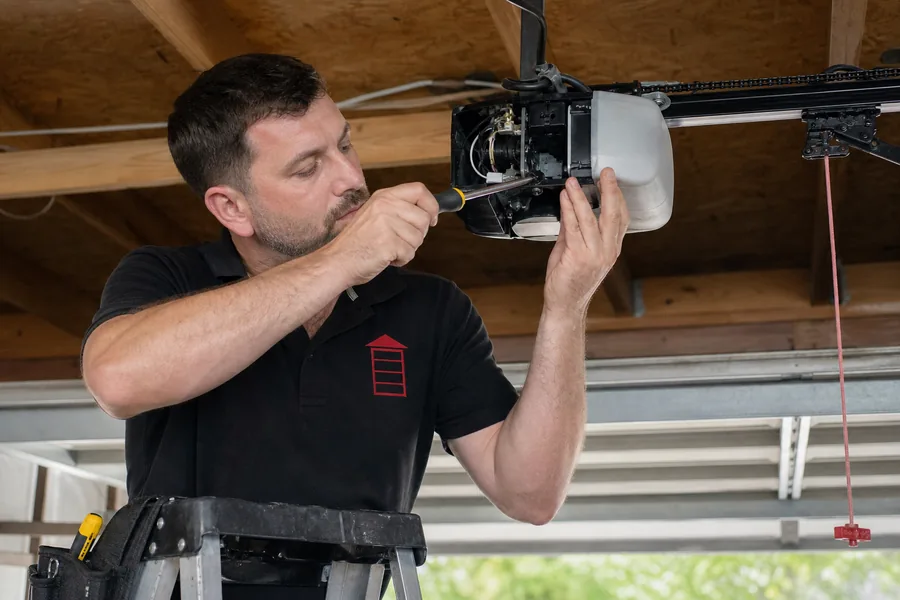
Motor runs, door does nothing? That is a stripped nylon gear, and a gear kit costs a fraction of a new opener. We diagnose before we sell.
Most garage door opener repair calls we take in Pittsburgh start the same way - the door moved fine yesterday. That is normal. The components that fail are load-bearing, and load-bearing parts fail suddenly rather than gradually. In Pittsburgh, repeated freeze-thaw cycles crack panels and seize rollers, which is why we carry the parts for it on the van rather than ordering them in.
An opener does not lift anything. It positions a door that the spring has already made weightless, and holds it where it is put. The motor turns a worm which drives a nylon gear, and that gear is soft on purpose - engineered to be the first thing to fail, because a stripped gear is a cheap afternoon and a burned-out motor or a bracket torn off a door is not.
The van covers Pittsburgh and Mount Lebanon, Bethel Park, Monroeville, Robinson daily. You get a two-hour window rather than a day, a free written estimate, and a price that does not move between the driveway and the invoice.
A stripped gear has a distinctive symptom: the motor runs, sounds completely normal, and the door does not move at all. If you hear the motor and see nothing happen, that is the gear, and a gear kit costs a fraction of a new opener.
If any of that matches, a technician can diagnose it on site in about ten minutes. We do not guess at it down the phone, and we do not charge to look.
A chain-drive opener runs 12 to 15 years. A belt drive runs about the same but quietly. What kills them early is not age but load: an opener that has been pulling against a weak spring for a year has been working several times harder than it was designed to, and the gear inside is plastic.
Four faults cover most of what we see: photo eyes knocked out of alignment, a stripped drive gear, a limit switch that has drifted, and a failed logic board. The first three are inexpensive parts and an hour. The fourth is the one that sometimes makes a new opener the better money, and we will tell you which you are looking at before you commit to anything.
If the opener is over fifteen years old and the board has gone, replacing it is usually the better money - a modern head is quieter, has a rolling code remote, and comes with its own warranty. We will say so plainly rather than selling you a board for a unit that is finished.
None of this involves touching anything under tension, and all of it makes the phone call shorter and the estimate more accurate. Two minutes in the garage with the door down is enough.
Whatever you find, do not try to correct it. The value is in the description you give us, not in the repair - a technician arriving in Pittsburgh who already knows what failed arrives with the right part on the van.
Two quotes for the same job in Pittsburgh can differ by a lot and both be honest, because they are not for the same work. This is what ours includes as standard.
If a quote you have been given elsewhere does not include the balance check and the safety reversal test, it is not finished work. Those two steps decide whether the repair lasts and whether the door is safe around people.
You do not need tools and you do not need to touch anything under tension. Stand in the garage with the door shut and look at four things.
The springs above the door: any orange-brown bloom on the coils is surface rust, and surface rust is where the spring will eventually break. The gap in a broken spring is obvious once you know to look for it.
The cables running down each side: follow them to the bottom brackets and look for strands standing proud of the lay of the wire. Frayed is the warning; snapped is the emergency.
The rollers: spin one with a finger. It should turn freely. A roller that will not turn is dragging in the track and taking the track with it.
And the balance: release the opener with the door down, lift by hand to waist height, and let go. It should stay. Anything else means the counterbalance needs setting.
Almost every residential door in Pittsburgh is standard torsion hardware, and standard hardware is what the van carries. Two exceptions come up often enough to be worth naming: Wayne Dalton's TorqueMaster, where the spring lives inside the tube, and the direct-drive European heads.
| Brand | Notes |
|---|---|
| Overhead Door / Raynor | Standard torsion hardware on the residential lines - nothing unusual to source. |
| Craftsman | Built on Chamberlain internals for most of their production run, so the gear kits and boards are shared and readily available. |
| Clopay | The most common door brand we work on. Panels, hinges and struts are orderable individually, so one damaged section does not mean a whole door. |
| Sommer / Marantec | Less common here, direct-drive heads, and the parts have to be ordered - so we confirm the model before the van is loaded. |
| Chamberlain myQ | Wi-Fi hubs and the app side fail more often than the mechanics do. Usually a re-pair rather than a replacement. |
| Genie | Screw-drive and belt-drive heads. Intellicode remotes and carriage assemblies are the usual failure points, and both are parts rather than a reason to change the opener. |
Not listed is not a problem. Residential doors are overwhelmingly standard hardware, and the handful that are not are identified from the model number in about ten seconds on the phone.
Photo eyes are the part worth caring about. Every unit sold in the United States since 1993 has them, and if the door does not stop and reverse when that beam is interrupted, the safety system is not working - that is a different category of problem from an inconvenience. Test it monthly with something solid laid flat, and we test it on every visit whether or not it is why we were called.
Doing nothing is genuinely the right move here, which is not advice people are used to getting. A door that has already failed does not deteriorate sitting still; it deteriorates every time somebody presses the button to see whether it is still broken.
The one exception is getting a car out. Release the opener with the door fully closed, lift with your legs, and stop immediately if it feels heavy - heavy means the counterbalance is not working and the door will come back down on its own.
Anyone can quote this job blind. What they cannot do is know which of these apply to your door, which is why our estimate happens in your garage rather than on the phone.
| Factor | Why it matters |
|---|---|
| Whether the door is the real problem | An opener straining against a weak spring is a spring job, not an opener job. Diagnosing the wrong one is how people buy two openers. |
| Age of the unit | Boards for a fifteen-year-old head are sometimes available and sometimes not, and when they are not the answer is a new opener rather than a hunt. |
| Wired or wireless fault | A dead wall control is often a broken low-voltage wire, not a board. The two are an order of magnitude apart in price. |
| Horsepower needed | A heavy insulated double door needs more than the builder-grade half-horsepower unit it probably came with. |
| Which of the four faults it is | Photo eyes, drive gear, limit switch or logic board - the smallest and the largest of those are an order of magnitude apart. |
The technician goes through whichever of those apply to your door before writing the estimate, so the number you are given is the number on the invoice.
We cover the whole of Pittsburgh, including Squirrel Hill, Shadyside, Brookline, Mount Washington, Bloomfield, South Side, and the towns around it - Mount Lebanon, Bethel Park, Monroeville, Robinson.
Just outside that list is still worth a call. Most of Allegheny County is inside the normal radius, and we will tell you honestly on the phone if you are not rather than booking you in and cancelling later.
Most garages in Pittsburgh are steep-driveway rowhouses and hillside garages built into the slope. That single fact drives more of what goes wrong than the weather does, because it sets the door's weight, and the door's weight sets everything else - spring size, cable gauge, how hard the opener works.
A double door in Pittsburgh runs 130 to 190 pounds, more if it is insulated. That weight is cancelled by the spring, carried by two cables, and steered by rollers in a steel channel. Take any one of those three out and the other two fail within days.
Around Squirrel Hill and South Side we see the consequences of that chain often enough to recognize them on the phone. A description of the noise usually tells us which of the three went first, and what else it has already damaged.
Which is the practical reason to call somebody who works this area rather than a dispatch number: the diagnosis starts before the van leaves.
Repeated freeze-thaw cycles crack panels and seize rollers. Split by component, the effect is not evenly distributed:
| Part | What the local climate does to it |
|---|---|
| Torsion spring | Surface corrosion removes section, stress concentrates there, and the spring fails short of its cycle rating. |
| Lift cables | Rust starts at the bottom bracket end, closest to the floor, and works up the lay of the wire. |
| Rollers | Grit and moisture together destroy unsealed bearings; sealed nylon rollers are largely immune. |
| Bottom seal | Hardens, cracks, and stops sealing - after which the weather is inside the garage rather than outside it. |
| Opener | Suffers indirectly. Every one of the above makes the door heavier to move, and the nylon drive gear is what pays for it. |
None of it is exotic and none of it needs a special product. It needs looking at twice a year, which is the part most people in Pittsburgh skip.
Yes - card, and we issue a written invoice for every job. Nothing is cash-only and nothing is priced on the doorstep.
Most garage door opener repair jobs are finished within the same visit, typically under two hours.
Yes - Mount Lebanon, Bethel Park, Monroeville, Robinson and the wider Allegheny County area are all inside our normal service radius.
Yes - LiftMaster, Chamberlain, Genie, Craftsman, Clopay, Amarr, Wayne Dalton and the rest. The mechanisms are common across brands and we carry parts for all of them.
Usually, yes. We hold same-day slots for Pittsburgh and the surrounding towns, and a door stuck open or a car shut in goes to the front of the list.
A chain-drive opener runs 12 to 15 years. A belt drive runs about the same but quietly. What kills them early is not age but load: an opener that has been pulling against a weak spring for a year has been working several times harder than it was designed to, and the gear inside is plastic.
There is no pressure attached to the call. Plenty of people ring to find out whether something is urgent, get told it is not, and book for next week. That is a perfectly good outcome and it costs nothing.
If it is urgent - a door standing open, or a car shut in - say so and it moves to the front of the list. Pittsburgh, Allegheny County and the towns around it.
Name, number and what the door is doing is enough. Everything before the price is agreed costs you nothing, across the whole of Allegheny County.
Prefer to talk it through? Call (412) 226-4206.
Rated in cycles, not years, and it uses them faster than anyone expects. When it breaks the full weight of the door lands on a motor built to position it, not lift it.
What this costs and how fast →A door that comes off once comes off again unless the cause is found. Usually a seized roller, a slipped drum or a loose bracket.
What this costs and how fast →Replaced in pairs, drums reset equally, and sealed nylon rollers where the originals were unsealed plastic. Quieter, and several times the life.
What this costs and how fast →Door stuck open overnight, or the car shut in. Same-day and after-hours, with the common parts already on the van.
What this costs and how fast →Rot or rust across more than one section, or repairs arriving more than once a year. At that point you are buying a door in installments.
What this costs and how fast →